
Title: Engineering Q&A: How to Choose an Anti-Jamming Anti-Spoofing Integrated GNSS Receiver for Harsh RF Environments
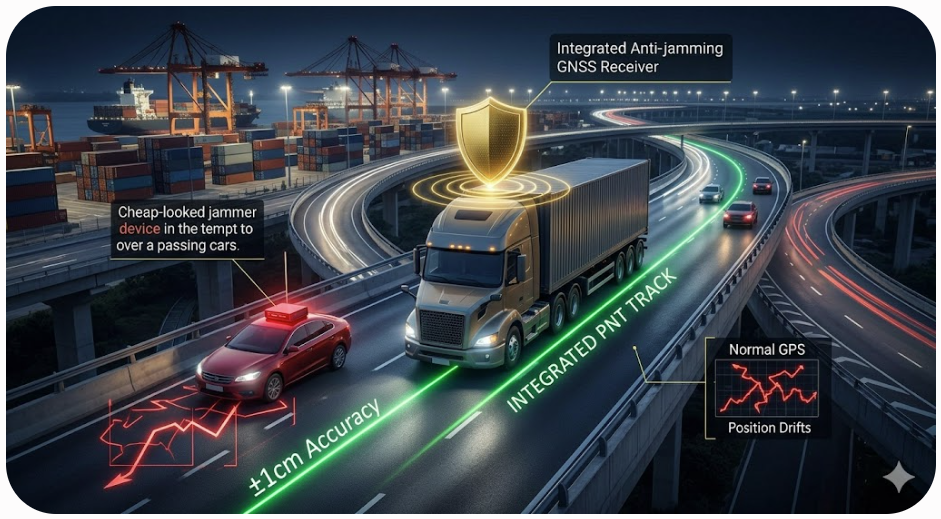
Recently, many robotics and UAV hardware engineers have raised the same concern in our communities: “Whenever our autonomous rovers get close to cell towers or heavy industrial zones, we get ‘GNSS Exception’ errors, the tracking drifts wildly, or we lose RTK completely. How do we fix this?”
Let’s break down the fundamentals of High-Precision Anti-Jamming Anti-Spoofing Integrated GNSS and how to choose the right hardware for your project.
Q1: Are “Anti-Jamming” and “Anti-Spoofing” the same thing?
Not at all. They address completely different threat vectors.
- Anti-Jamming deals with “brute-force noise.” It’s like someone blasting a siren right next to you. Anti-Jamming technology (hardware filters or CRPA nulling) acts like noise-canceling headphones, silencing the roar so the receiver can hear the quiet satellite signals.
- Anti-Spoofing deals with “deception.” The spoofer doesn’t shout; instead, it crafts a fake signal that looks exactly like a real satellite to trick your receiver. The receiver must use advanced algorithms (such as measuring the Signal’s Angle of Arrival or multi-correlator checks) to verify the authenticity of the source.
Q2: Why is “Integration” the biggest trend right now?
Historically, implementing anti-jamming meant buying a massive, expensive CRPA antenna array, running it into a heavy, dedicated anti-jamming processor, and then outputting that to a separate GNSS receiver. The weight, power consumption, and price tag made it impossible to put on a commercial drone or a compact delivery robot. Modern Integrated Receivers handle all RF filtering, digital signal processing, and defense algorithms directly on a single compact board or chip. You get the same—or better—performance at a fraction of the size, weight, and power (SWaP).
Q3: What specs should an engineer focus on during component selection?
- Jammer-to-Signal Ratio (J/S or INR): This defines how much noise the system can filter. Standard commercial modules handle very little, whereas premium integrated modules achieve 60 to 65 dBc or higher.
- Threat Profiling: Does the module filter out multiple types of interference? Jammers use sweep, multi-tone, narrowband, and pulse waves. A simple single-frequency filter won’t cut it.
- Inertial Coupling (GNSS+INS): Look for a system that offers deeply coupled GNSS/INS integration. If a jammer completely overpowers the sky, the high-rate inertial navigation system acts as your safety net, maintaining orientation and positioning via dead reckoning until the signal is recovered.
